

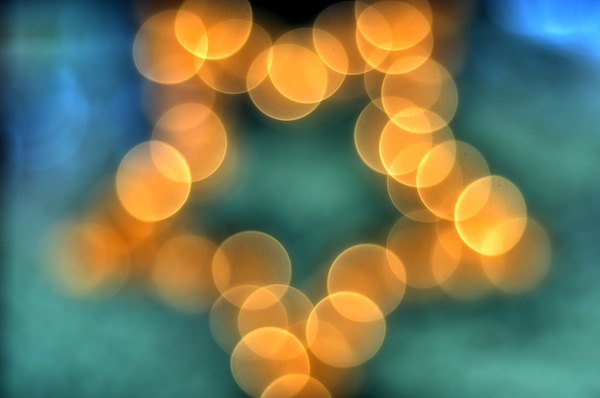
Original Bokeh is a Japanese word meaning 'blurred', so is the bokeh photograph photographs that highlight the characteristics of a main object of focus is very sharp while the background (or foreground) is very vague, or in English selective focusing. In the example above the beautiful photos (the work of Sector Two), the main object model face is very sharp, but the background is the door to look very blurry (motion blur). Well, nature is called bokeh blurred. How can so that we can produce bokeh like this photo.
The emergence of bokeh in the photo still want any moving picture is influenced by various factors
interacting, among others:
1. The distance between the main part of image / subject to background / foreground
Generally bokeh will look when the distance between the main object with background / foreground far enough. But distance is not a fixed variable in obtain bokeh, still influenced by other factors, as well as the good and bad bokeh.
2. Large aperture
Difficult to bring up the narrow aperture bokeh. Generally bokeh will look at large aperture provided background / foreground blur is not maximal. That is bokeh will look when the piece is still indistinguishable dark light or still have gradation.
3. Lens focal / focal length
The bigger the fire point of a lens, the more possible since the advent bokeh DOF increasingly narrow. The use of wide angle lens is very difficult to produce bokeh.
4. Type / design of the lens including the lens of pieces of material
Lens design does not directly affect the onset of bokeh, but very effect on the quality of bokeh produced. But unfortunately, not high-quality lens necessarily produce good bokeh quality. Lenses with different corrections, which improve the sharpness of the image, it produces worse quality bokeh.
Lens reflex (Catadioptric lens), which include elements of the lens with a mirror, cause the typical ring-shaped bokeh, donut-shaped. This happens because the center of the cone of light is not blocked by the focus ring mounted mirror right in the middle circumference of the lens (the smaller the circumference of the mirror)
Soft lenses, generally produce less good bokeh, because the center of each bokeh less soft than the point of interest, so we need special filters to fix it.
(Note: different from the soft out of focus in general)
5. The number and shape of pieces / blade diaphragm
Number of diaphragm and pieces do not really have a direct link with the onset of bokeh, but only contributes to the shape bokeh. Most of the lens maker always linking number plate diaphragm with bokeh quality, and unfortunately accepted this opinion by most photographers, especially those who lack understanding of optical physics. in understanding they are, more shape of pieces, more better for bokeh. When in fact the many pieces of diaphragm just make bokeh more rounded shape, with consequences the more expensive lenses. There are other things about the pieces of the diaphragm is to know, ie the number of odd pieces of the diaphragm, can cause effects that are sometimes sought after photographers, the beam star-shaped around a very bright spot in the region out of focus. But generally appear the narrow aperture. The number of beam lines generated 2 times the shape amount, eg: diaphragm with a number of chips 5, will cause a star shape with 10 rays at each point of light. Diaphragm with an even number of chips just cause star shape with the number of jets equal to the number shape of pieces so that the diaphragm 8 pieces produce only stars with eight rays. But once again we must emphasized that it was only in form, not on the distribution of rays that cause bokeh.
interacting, among others:
1. The distance between the main part of image / subject to background / foreground
Generally bokeh will look when the distance between the main object with background / foreground far enough. But distance is not a fixed variable in obtain bokeh, still influenced by other factors, as well as the good and bad bokeh.
2. Large aperture
Difficult to bring up the narrow aperture bokeh. Generally bokeh will look at large aperture provided background / foreground blur is not maximal. That is bokeh will look when the piece is still indistinguishable dark light or still have gradation.
3. Lens focal / focal length
The bigger the fire point of a lens, the more possible since the advent bokeh DOF increasingly narrow. The use of wide angle lens is very difficult to produce bokeh.
4. Type / design of the lens including the lens of pieces of material
Lens design does not directly affect the onset of bokeh, but very effect on the quality of bokeh produced. But unfortunately, not high-quality lens necessarily produce good bokeh quality. Lenses with different corrections, which improve the sharpness of the image, it produces worse quality bokeh.
Lens reflex (Catadioptric lens), which include elements of the lens with a mirror, cause the typical ring-shaped bokeh, donut-shaped. This happens because the center of the cone of light is not blocked by the focus ring mounted mirror right in the middle circumference of the lens (the smaller the circumference of the mirror)
Soft lenses, generally produce less good bokeh, because the center of each bokeh less soft than the point of interest, so we need special filters to fix it.
(Note: different from the soft out of focus in general)
5. The number and shape of pieces / blade diaphragm
Number of diaphragm and pieces do not really have a direct link with the onset of bokeh, but only contributes to the shape bokeh. Most of the lens maker always linking number plate diaphragm with bokeh quality, and unfortunately accepted this opinion by most photographers, especially those who lack understanding of optical physics. in understanding they are, more shape of pieces, more better for bokeh. When in fact the many pieces of diaphragm just make bokeh more rounded shape, with consequences the more expensive lenses. There are other things about the pieces of the diaphragm is to know, ie the number of odd pieces of the diaphragm, can cause effects that are sometimes sought after photographers, the beam star-shaped around a very bright spot in the region out of focus. But generally appear the narrow aperture. The number of beam lines generated 2 times the shape amount, eg: diaphragm with a number of chips 5, will cause a star shape with 10 rays at each point of light. Diaphragm with an even number of chips just cause star shape with the number of jets equal to the number shape of pieces so that the diaphragm 8 pieces produce only stars with eight rays. But once again we must emphasized that it was only in form, not on the distribution of rays that cause bokeh.
Now i'll give tips how to make a bokeh photography :
- Use / set the camera on manual mode (Aperture Priority)
- Use the aperture as much as possible, usually there is writing on the lens f / x, the smaller the aperture the greater x is.
- Calculate the distance to the object background images, if the distance to objects far background the importance of the photo is very blurry.
- Use of Non-Zoom lens with high aperture
- Many training course


